St. John Chrysostom-Vice and Virtue

Let no man then of those who live in vice despair; let no man who lives in virtue slumber.

St. John Chrysostom

Where Is Your Faith?

If only, with firm resolve, we begin to live according to God's law, we do not need to fear any sort of attack from those who do not understand, for to him who has truly begun to live according to God's Law, all that happens to him at the hands of men, happens for his profit and to the glory of God. It is especially necessary not to fear being forced to move from a place we like to a place we dislike, a place of fear and uncertainty, unfathomable as to God's plan in it for us. 

The Holy Great-Martyr Demetrius

This glorious and wonderworking saint was born in Thessalonica of noble and devout parents. Implored of God by childless parents, Demetrius was their only son, and so was raised and educated with great care. Demetrius's father was a commander in Thessalonica. When his father died, Emperor Maximian appointed Demetrius as commander in his place.

As he appointed him, Maximian, an opponent of Christ, particularly recommended that he persecute and exterminate the Christians in Thessalonica. Demetrius not only disobeyed the emperor but openly confessed and preached the Lord Jesus Christ in the city of Thessalonica. When the emperor heard of this he became furious with Demetrius. Then, when he was returning from battle against the Sarmatians, Maximian stopped at Thessalonica to investigate the matter.

Monk Moses of Mount Athos: The Mature Fruit of Prayer

The power of prayer is to be found in its mature fruit, increasingly savored by the believer as he persists in long struggle.  Abba Neilos says that prayer is protection against sadness and discouragement, which means that prayer protects the soul from the sins of dispirited sadness, despondency, oppression and despair.  And he adds: "It is prayer which blossoms the spirit of meekness and peacefulness."  These virtues are fruits of prayer, not acquired by momentary action, but requiring continuous fervent effort.

The most discerning St. John of the Ladder refers to prayer as the source of virtues, the nourishment of the soul, the enlightenment of the mind, the weapon which cuts off despair, the overcoming of grief, the reduction of wrath, the mirror of progress, the indicator of moderation, and the true reflection of our spiritual condition.

From Athonite Flowers: Seven Contemporary Essays on the Spiritual Life

Alexendar Schmemann -- The Mission of Orthodoxy


The Mission of Orthodoxy

by Father Alexander Schmemann

[Adapted from a lecture given at the 1968 National Conference of Orthodox College Students and printed in Volume III, No.4 of CONCERN (no longer in publication).]
This article is available in pamphlet form here from Conciliar Press

What is the role and task of Orthodox Christians in America? Too often we want solutions to problems which we have not formulated, progress toward a point which we have not yet defined, victories in battles in which we don't know who is fighting whom.

The time has come to clarify the issues, to formu­late the problems we face together, to discuss the solutions and the priorities in our existence as Ortho­dox in a Western country which is our country. Are we a group of exiles? Are we a spiritual and cultural ghetto, to be perpetuated against all odds? Are we to dissolve ourselves here in what is called "the Ameri­can way of life"?  What is this American way of life?

It is my purpose to deal with the fundamental framework of these questions. In my first lecture to freshmen at Saint Vladimir's Seminary, I always use the same symbol: If you have a big library and move into a new house, you can't use that library unless you build shelves. While it is still in boxes, you own that library, but it is of no use to you. My purpose, then, is to build the shelves and then to try to see what are the priorities of our Orthodox situation today.

It is impossible to speak about our situation in America unless we refer it to our normal and essential term of reference, the Orthodox Church. The Ortho­dox Church--whether Greek, Syrian, Serbian, Romanian, or Bulgarian--has always been both the heart and the form of an Orthodox world. Only here in the West, and for the first time in the history of Ortho­doxy, do we think of the Church in terms only of a religious institution such as diocese, parish, and so on. No one in organically Orthodox countries has ever thought of the Church as being distinct from the total­ity of life. Since the conversion of Constantine, the Church was organically related to society, culture, education, family, etc. There was no separation, no dichotomy. The Russian word for peasant is simply christianin, which at the beginning obviously meant Christian.

Here, then, we find the first radical difference which we have to face in America: We belong to the Orthodox Church, but we do not belong to an Ortho­dox culture. This is the first and most important change, and unless we understand that this is not an academic proposition, but the real framework of our existence, we will not see clearly through our situa­tion. For everything in the Orthodox Church points toward a way of life; the Church is connected to all aspects of life. Yet we are deprived of this connection because, upon leaving our churches on Sunday morn­ing, we return to a culture which was not produced, shaped, or inspired by the Orthodox Church and which, therefore, in a way is deeply alien to Ortho­doxy.

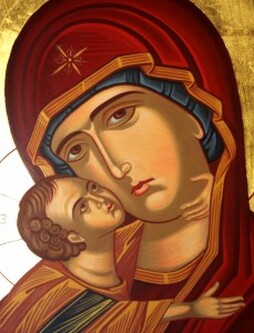
Akathist to the Mother of God for Children

Kontakion 1

Victorious Leader and Good Nurturer of the Christian race, we Thy servants, delivered from evil, sing out grateful thanks to Thee. But as Thou hast invincible might deliver my children from all dangers that with tears I may cry to Thee: Raise my children (names), to be made worthy of the Kingdom of Heaven, and make them heirs of eternal blessings.

Ikos 1

Intercede with Thy Son and God, O most Holy One, that an angel from heaven be sent to my children, just as to Thee was sent a most mighty protector, the Archangel Gabriel; and vouchsafe me to cry to Thee thus:

    Raise my children to be earthly angels.
    Raise my children to be heavenly men.
    Raise my children to be Thy servants.
    Raise my children to cry out to Thee:
    “Rejoice, O Full of Grace, the Lord with Thee!”
    Raise my children (names), O Lady, to be made
    worthy of the Kingdom Of Heaven and make
    them heirs of eternal blessings.

Order for Standalone Akathist without a Priest

Use the following order to pray the Akathist hymn at home without a priest.

Opening

Through the prayers of our holy fathers, Lord Jesus Christ our God, have mercy upon us.

The Trisagion Prayers

Holy God, Holy Mighty, Holy Immortal, have mercy upon us.

Glory to the Father, and to the Son, and to the Holy Spirit,
Both now and ever and unto ages of ages.  Amen

All Holy Trinity have mercy on us.
Lord, cleanse us from our sins;
Master, pardon our iniquities;
Holy God, visit and heal our infirmities for thy sake.

Eastern Orthodox Christian Evangelism is different

Here is an article posted on the St Nicholas Russion Orthodox Church site pertaining to Evangelism.  You can view the article by clicking here: 

Syndicate content